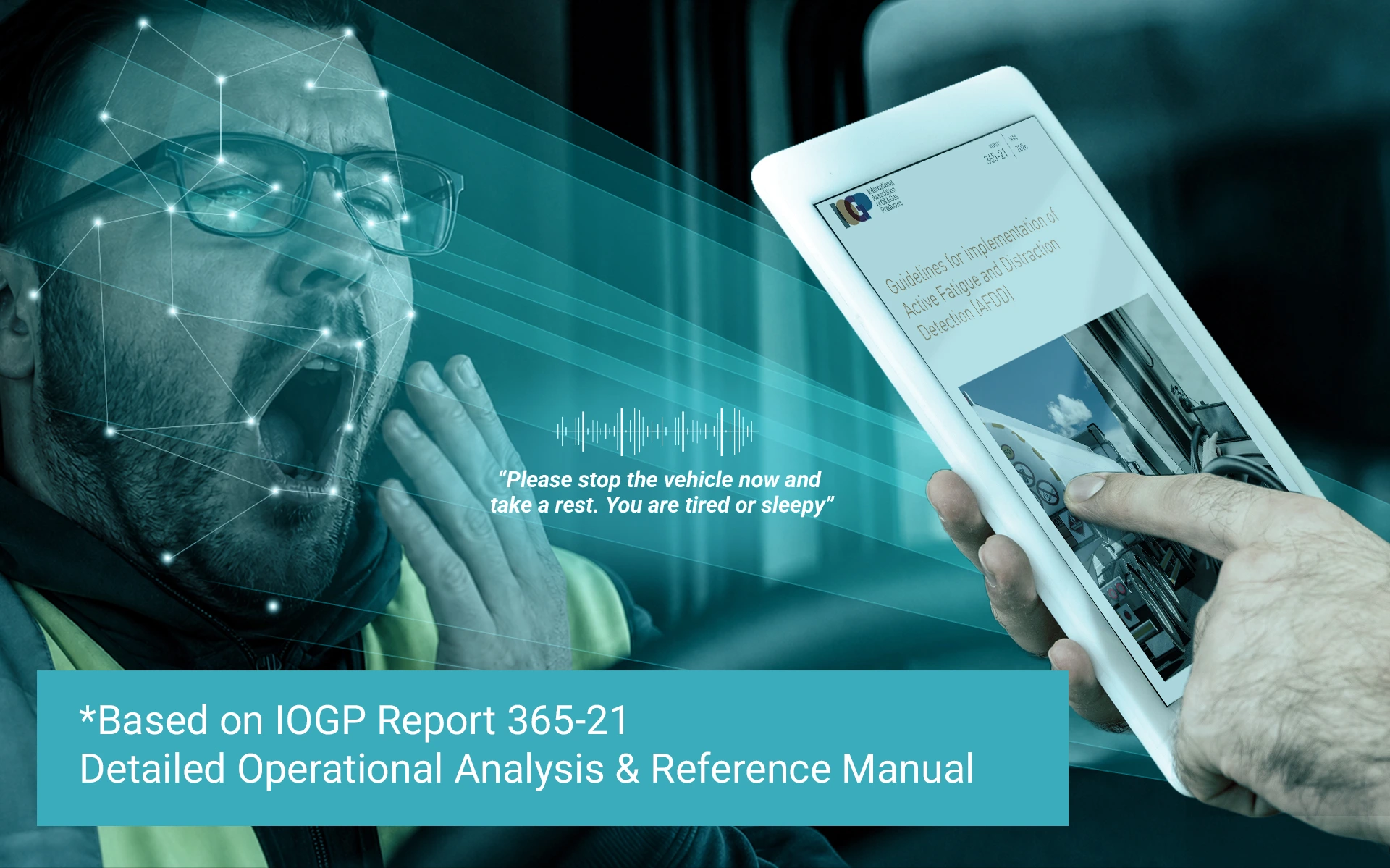
In the global logistics and oil and gas sectors, road transportation remains one of the highest exposure activities. Statistical analyses consistently reveal that human behavior is the root cause of most transport incidents. Specifically, research demonstrates that human behavior directly constitutes more than 90% of all Motor Vehicle Crashes (MVCs). with driver fatigue and distraction among the leading contributing factors. While traditional in-vehicle tracking has historically relied on reactive metrics, one of the most effective advancements in vehicle safety today is Active Fatigue and Distraction Detection (AFDD) technology, which represents a paradigm shift toward real-time, preventative intervention.
Active Fatigue and Distraction Detection (AFDD) is an intelligent driver monitoring technology designed to identify behaviors associated with reduced alertness or loss of focus while driving. This technology differs fundamentally from standard fleet management systems. In addition to telematics, AFDD utilizes advanced hardware, algorithms, and sensors to analyze indicators and assess the driver’s physical and cognitive abilities. It achieves this by tracking robust behavioral proxies, including eye gaze direction, eye closure duration, head positioning, and facial movement patterns.


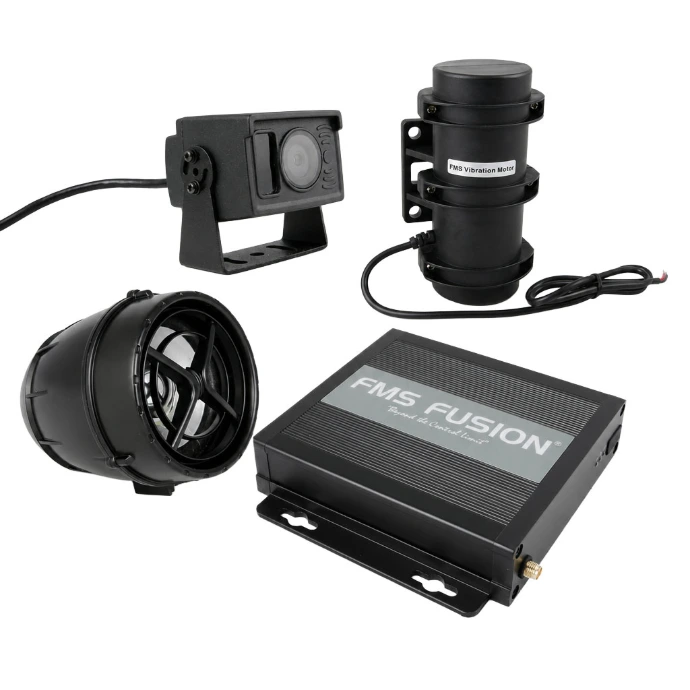
According to the IOGP report, an authorized AFDD architectural deployment consists of three primary interconnected hardware elements:

Connected directly to the controller unit, this module provides localized physical feedback directly through the driver's seat, operating in tandem with audible alarms to ensure immediate driver sensory engagement.
Positioned to face the driver, this unit tracks facial characteristics. In jurisdictions where driver-facing video recording is legally restricted, the system can operate dynamically utilizing an Infrared (IR) sensor array alone, tracking facial data without retaining or recording raw video streams.
The edge-computing processing brain of
the vehicle, running custom machine-learning algorithms to interpret the
real-time sensor streams and determine whether parameters have been exceeded.

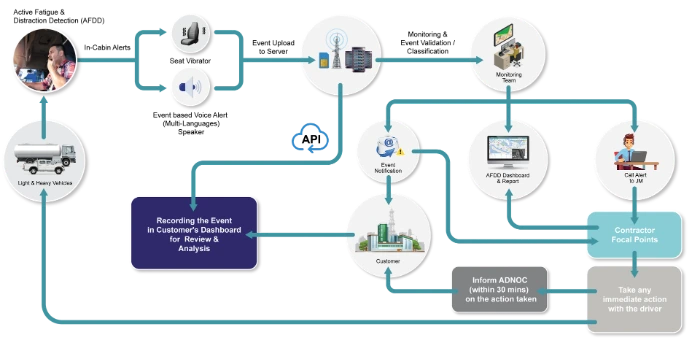
Every recorded AFDD transaction includes in its timeline a strict five-stage step designed to optimize safety outcomes
Event Occurrence
In-Cabin Real-Time Driver Alerting
Closed-Loop Remote Analysis and Validation
Journey Supervisor Monitoring & Intervention
Post-Journey Driver
Coaching
Fatigue events are detected behaviors that are characterized by a lack of alertness of psychomotor capabilities, sensory processing, and spatial awareness. AFDD systems break these down into three core classifications:


Involuntary wide mouth openings coupled with deep inhalation. While multiple yawns (such as two instances within a rolling 60-second window) indicate a clear need for supervisor attention, yawning events should generally be excluded from a driver's formal safety score to prevent penalizing natural non-fatigue physiological responses.
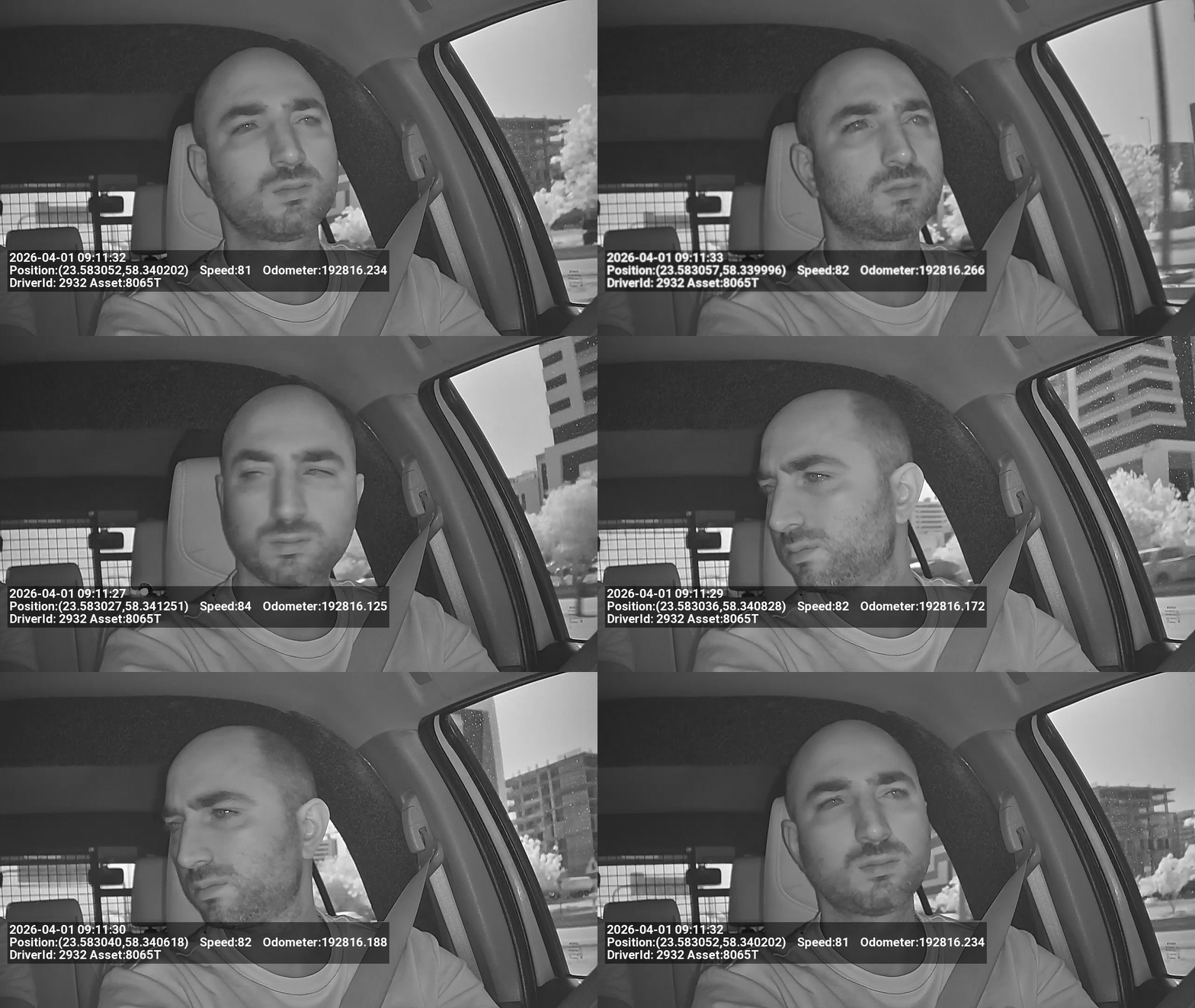
Defined operationally as an uncontrolled episode where the driver loses control of their neck muscles and exhibits extended eye closure. Under standard operating criteria, any continuous eye closure lasting t ≥ 1.5 seconds or t ≥ 2.0 seconds while the vehicle speed v > 10 ext{ kph} or v > 8 ext { kph} triggers an immediate high-risk event category.
A state where an driver is actively fighting the onset of fatigue, marked by dramatically slowed eyelid movements or repetitive, micro-closures.

To implement an effective operational strategy, companies must configure distinct parametric boundaries for fatigue and distraction events. If threshold parameters are set too tight, fleets suffer from alarm fatigue; if they are set too loose, critical near-miss events are missed entirely. The IOGP framework highlights two prominent reference models utilized by major operators (Company A and Company B) to establish threshold controls.
Distractions are divided into four sensory groups: visual (looking away from the roadway), manual (removing hands from the steering wheel), auditory (focusing on complex audio inputs), and cognitive (mental preoccupation). AFDD hardware categorizes these into two high-risk metrics:


Verified when an operator’s eye gaze or head positioning shifts completely away from the forward windscreen angle for a continuous period of t ≥ 4.0 seconds while vehicle speed v > 40 ext{ kph}. This includes specific classifications like mobile phone manipulation (handling an object resembling a phone for ≥ 3 seconds) or notifiable distracted driving (such as eating or multitasking with both hands off the steering wheel).
Tracks cumulative short distractions. A VATS hazard is triggered when a driver cumulatively glances away from the roadway for a total of 10 seconds within a rolling 30-second window, signalling that their attention is dangerously fragmented.
When an AFDD asset captures an anomalous tracking event, it records a brief video clip, typically encompassing five seconds before the trigger and five seconds after the trigger. To process this data meaningfully without overwhelming the business, a staged verification engine loop is employed
Deployment Phase | Verification Engine | Operational Objective |
Staged Validation | Hybrid (AI + Human Analyst Review) | Human analysts review control room footage to validate AI alerts, filter out false positives, and train localized machine learning algorithms. |
Automated Validation | Pure AI Automated Verification | Once system algorithms reach high verified reliability for a specific fleet environment, automated data streams manage event classification directly. |
Once validated, these events flow into the organization's broader safety structures. One-off high-risk distractions are typically compiled for post-journey supervisor reviews, whereas repeated high-risk fatigue events (like multiple microsleep) trigger real-time, live journey interventions to get the driver to a safe rest area.
By transforming raw physical behaviors into clean, quantitative data, AFDD empowers organizations to understand exactly where fatigue and distraction risks reside before they ever result in an incident on the road.
Reference:
International Association of Oil & Gas Producers (IOGP). Guidelines for Implementation of Active Fatigue and Distraction Detection (AFDD), IOGP Report 365-21.
Available at: https://bit.ly/IOGP-Report-365-21